from www.wagneropera.comWilhelm Richard WagnerBorn: Leipzig, Kingdom of Saxony, 22 May 1813Died: Venice, Italy, 13 Feb. 1883 | 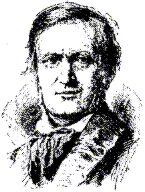 |
Operas
The dates and locations are those of the premieres; when there was a substantial delay between composition and performance, the year of completion is also given. Revisions are listed separately.- Die Hochzeit (1832; 1938 Leipzig) (fragment)
- Die Feen (1834; 29.6.1888 Munich)
- Das Liebesverbot (29.3.1836 Magdeburg) (Die Novize von Palermo)
- Rienzi, der letzte der Tribunen (20.10.1842 Dresden)
- Der fliegende Holländer (2.1.1843 Dresden)
- Tannhäuser und der Sängerkrieg auf Wartburg (19.10.1845 Dresden)
- Lohengrin (28.8.1850 Weimar)
- Tristan und Isolde (1859; 10.6.1865 Munich)
- Tannhäuser und der Sängerkrieg auf Wartburg [rev] (13.3.1861 Opéra, Paris)
- Die Meistersinger von Núrnberg (21.6.1868 Munich)
- Der Ring des Nibelungen (13-17.8.1876 Festspielhaus, Bayreuth):
- Das Rheingold (1854; 22.9.1869 Munich)
- Die Walküre (1856; 26.6.1870 Munich)
- Siegfried (1869; 16.8.1876 Festspielhaus, Bayreuth)
- Götterdämmerung (17.8.1876 Festspielhaus, Bayreuth)
- Parsifal (26.7.1882 Festspielhaus, Bayreuth)
Creators of Roles
FROM www.enotes.com
Libretti
In addition to the libretti of all of his own operas, Wagner also supplied one libretto set by another composer:Richard Wagner 1813-1883
German dramatist, composer, and essayist.
INTRODUCTION
The following entry presents criticism on Wagner from 1984 through 1999. For further information on Wagner's life and career, see NCLC, Volume 9.Recognized as an outstanding nineteenth-century composer, Wagner also distinguished himself as a dramatist and theoretician whose works profoundly influenced modern literature. Wagner's many operas and innovative dramatic theories, as well as his powerful personality, have consistently elicited substantial commentary. Der Ring des Nibelungen (1853; The Ring of the Nibelung), his most widely acclaimed work, embodies many of his theories, including the use of cyclic structure, leitmotiv, and myth. Wagner's conception of Greek tragedy and interpretation of the pessimistic and materialistic philosophies of Arthur Schopenhauer and Ludwig Feuerbach also inform his operas. Like the ancient Greek dramatists, Wagner combined myths, symbols, and various art forms to express human and social aspirations. His primary goals were to create a Gesamtkunstwerk, or unity of the arts, through a synthesis of music, poetry, and dance, and to portray the ideal human being..
Critical Reception
Wagner's operas and aesthetic theories have consistently inspired great critical controversy. During his lifetime, Wagner was simultaneously rejected as a modernist whose operas and aesthetics were incomprehensible and untenable and hailed as a prophetic dramatist and composer whose works would revolutionize modern art. Several periodicals were founded exclusively to discuss his works, and by the early twentieth century, more than ten thousand books and articles had been written about him. Wagner's popularity steadily increased until World War I, when anti-German sentiment prevented the performance of his works outside his native land. In the 1930s and 1940s, Adolf Hitler's friendship with Wagner's daughter Eva and the use of his works as propaganda for the Nazi movement contributed significantly to the decline of the composer's international reputation. Criticism of this period noticeably reflects commentators' repugnance for Wagner's nationalism and anti-Semitism. While these subjects continue to elicit commentary, most modern literary scholars largely deem the parallels between Wagner and the Nazi movement extraliterary and focus instead on the works' dramatic qualities and philosophical sources. Through the end of the twentieth century, Wagner has been recognized as a foremost nineteenth-century dramatist and composer whose works have influenced myriad artists and artistic traditions, musical and literary.FROM www.bikwil.com
 It has fallen to me to be one of the less frivolous contributors to this Bikwil Wagner issue. What follows, however, is something which only on a charitable day might just pass for an "academic" or "formal" paper. This short article will thus not be particularly learned, and certainly it isn't boldly original. What it may be, though, is interesting enough to motivate further explorations by the new Wagner buff into a couple of the more technical aspects of the composer's art. To that end, as we proceed I'll provide references to the literature I found most illuminating while researching this topic. It has fallen to me to be one of the less frivolous contributors to this Bikwil Wagner issue. What follows, however, is something which only on a charitable day might just pass for an "academic" or "formal" paper. This short article will thus not be particularly learned, and certainly it isn't boldly original. What it may be, though, is interesting enough to motivate further explorations by the new Wagner buff into a couple of the more technical aspects of the composer's art. To that end, as we proceed I'll provide references to the literature I found most illuminating while researching this topic.The Vision Thing Before we can talk about Wagner's craft (at least that of his mature works Tristan, the Ring, Die Meistersinger and Parsifal) we must first address his Gesamtkunstwerk concept (= unified art form). In opera the method had long been to have the various scenes sung by isolated arias or choruses which rarely bore any musical relationship to each other. As a rule, operas set throughout to music (whether arias, recitatives, ensembles or choruses) were called "grand operas", while those with dialogue came to be known as "comic operas".Wagner's intention, by contrast, was to create a new kind of dramatic work, in which music, poetry, drama, acting, scenery and spectacle could be combined in a meaningful and expressive whole, and which was to be called, not "opera", but "music drama". The Collins Encyclopedia of Music [1] offers a deft summary of all the stipulations Wagner attached to the idea, which included legends as subject matter, verse written by the composer, the abandonment of conventions like the operatic ensemble, the orchestra as equally expressive partner to the voices, and symphonic continuity.From here on, however, I will be able to focus on just two design implications of the concept: melodic and orchestrational. I realise that this will omit a number of other important topics, but space limitations dictate such exclusions.Catchphrases Galore One device Wagner developed to help actualize his vision is known as the "leitmotiv".Contrary to a widespread misconception, neither the term "leitmotiv" nor the device itself was invented by Wagner. His word was “Grundthema” (= basic theme). The coinage of the word “leitmotiv” has sometimes been attributed to Friedrich Wilhelm Jähns [2], who was applying it, not to Wagner, but to Weber. Most commentators [3], however, confer the credit on H. von Wolzogen, the editor of Bayreuther Blätter, who employed it 1887 when discussing Götterdämmerung, and who gave the leitmotivs their well-known names.So what exactly is a leitmotiv? Simply put, in the words of the indestructible Anna Russell, "it merely means a signature tune" for persons, events, emotions and physical objects — a sort of motto chiefly used as a "device of presentiments and reminiscences" [4]. In a way, it resembles Berlioz' idée fixe in his Symphonie Fantastique of 1830, although Wagner made far more elaborate and consistent use of it, particularly in Der Ring des Nibelungen. The fascinating thing in that work is that, though each leitmotiv has its own easily remembered melodic characteristic (often harmonic and/or rhythmic as well), almost every one grows out of another previously heard.Sometimes the connections only become apparent in retrospect, but it is the symphonist's art to integrate large-scale structures, linking backward and forward to create a continuous text, rich in associative ideas. [5]The effect of this back-and-forth association of leitmotivs is thus an unbroken thematic development that ultimately binds the four dramas together into a cohesive, organic musical edifice, and helps give it its unity.These days there are many references available for the Ring student to explore in detail the meaning and interplay of the work's melodic fragments. One is a now out-of-print book by Aylmer Buesst [6], which narrates the full plot of the tetralogy, at the same time naming, numbering and notating each leitmotiv, original or derived, as it appears. Another is the magnificent Ring Disc CD-Rom, which allows you to search by leitmotiv, then hear it in context.For my money the most useful resource, however, is the recording made by Deryck Cooke [7] as part of the Decca re-release as an integrated set of its world's-first complete Ring recording. Cooke's masterly explanation consists of commentary and nearly 200 examples extracted from the Decca recordings, plus a printed version of both, the leitmotiv examples in musical notation.The advantage here, of course, is that you can look and listen at the same time. The only possible question arising is this: is the Cooke recorded commentary available separately? I’m not sure, but then, doesn't everyone need a Solti/Vienna PO Ring anyway?New Sounds for Old Coming now to the implications of the music drama concept for the use of the orchestra, I want to first clarify the acoustic importance of the design of the Bayreuth building itself. Modelling his auditorium on the sloping fan shape of an ancient amphitheatre, so that the lines of sight would be democratically favourable from all seats, Wagner did away with the private side boxes hitherto so valued by the European upper classes. Nor would he permit pillars or multi-storey galleries.At the same time he had the orchestra repositioned from its customary place into a sunken area in front of and partly beneath the proscenium. Orchestra and audience were separated by a low wall, and the source of the opera's music was now essentially invisible to the spectators. In this respect the Bayreuth Festspielhaus has had an abiding influence on all musical theatres subsequently built, with most theatre-goers today, however, blithely unaware that the orchestra pit they take for granted was Richard Wagner's invention. |

No comments:
Post a Comment
Note: Only a member of this blog may post a comment.