Wagner's operas created new pathways for future composers to continue with.
Wagner's operas are degenerate and too complicated to be fully appreciated by the audience.
Wagner's augmentation of the orchestra is unnecessary and did not greatly influence later orchestral performances.
Wagner created a new platform for the composers of the 20th century and his music is thus still relevant today.
Young people enjoy listening to pop/rock music because of the rhythm associated with the music which they can dance to.
Young people enjoy listening to pop/rock music for it provides them with subject matter with which they can associate.
Young people enjoy listening to pop/rock music because it encourages them to behave subversively, thus satisfying their rebellious nature.
There is no specific reason why young people enjoy listening to pop/rock music.
Friday, July 15, 2011

HANDY TERMINOLOGY - POP/ROCK MUSIC
| Noun | 1. | pop music - music of general appeal to teenagers; a bland watered-down version of rock'n'roll with more rhythm and harmony and an emphasis on romantic love popular music, popular music genre - any genre of music having wide appeal (but usually only for a short time)
|
HANDY TERMINOLOGY - WAGNER'S OPERAS AND ORCHESTRATION
op·er·a 1 ( p
p
 r-, pr)
pr-, pr)n.
1. A theatrical presentation in which a dramatic performance is set to music.
2. The score of such a work.
3. A theater designed primarily for operas.
Parsifal (pär`sĭfäl), figure of Arthurian legend Arthurian legend, the mass of legend, popular in medieval lore, concerning King Arthur of Britain and his knights. Medieval Sources
The battle of Mt. Badon—in which, according to the Annales Cambriae (c.
..... Click the link for more information. also known as Sir Percivale, who is in turn a later form of a hero of Celtic myth. The name originally occurs as Pryderi, an alternative name of Gwry in Pwyll Prince of Dyved, a tale in the Mabinogion Mabinogion , title given to a collection of medieval Welsh stories. Scholars differ as to the meaning of the word mabinogion: some think it to be the plural of the Welsh word mabinogi,
..... Click the link for more information. . Gwry is the original of Gawain, and in the later Percivale stories Gawain appears, often fulfilling the same role as the hero. The great feature of the Percivale cycle is the Holy Grail Grail, Holy, a feature of medieval legend and literature. It appears variously as a chalice, a cup, or a dish and sometimes as a stone or a caldron into which a bleeding lance drips.
..... Click the link for more information. , and Welsh sources connect this sacred talisman with Percivale, who finds the Grail. Chrétien de Troyes Chrétien de Troyes or Chrestien de Troyes , fl. 1170, French poet, author of the first great literary treatments of the Arthurian legend. His narrative romances, composed c.1170–c.
..... Click the link for more information. is the author of the first great artistic treatment of the theme; in Chrétien's unfinished poem Percivale finds the Grail at the Fisher King's castle and heals the king. The Parzival of Wolfram von Eschenbach is one of the greatest medieval poems. Drawn largely from Chrétien, von Eschenbach's story is highly spiritualized and appears essentially in the form used by Richard Wagner in his music drama Parsifal. In the Morte d'Arthur of Sir Thomas Malory Malory, Sir Thomas , d. 1471, English author of Morte d'Arthur. It is almost certain that he was Sir Thomas Malory of Newbold Revell, Warwickshire. Knighted in 1442, he served in the parliament of 1445.
..... Click the link for more information. , Percivale is admitted to the Grail with Galahad and Bors.
The battle of Mt. Badon—in which, according to the Annales Cambriae (c.
..... Click the link for more information. also known as Sir Percivale, who is in turn a later form of a hero of Celtic myth. The name originally occurs as Pryderi, an alternative name of Gwry in Pwyll Prince of Dyved, a tale in the Mabinogion Mabinogion , title given to a collection of medieval Welsh stories. Scholars differ as to the meaning of the word mabinogion: some think it to be the plural of the Welsh word mabinogi,
..... Click the link for more information. . Gwry is the original of Gawain, and in the later Percivale stories Gawain appears, often fulfilling the same role as the hero. The great feature of the Percivale cycle is the Holy Grail Grail, Holy, a feature of medieval legend and literature. It appears variously as a chalice, a cup, or a dish and sometimes as a stone or a caldron into which a bleeding lance drips.
..... Click the link for more information. , and Welsh sources connect this sacred talisman with Percivale, who finds the Grail. Chrétien de Troyes Chrétien de Troyes or Chrestien de Troyes , fl. 1170, French poet, author of the first great literary treatments of the Arthurian legend. His narrative romances, composed c.1170–c.
..... Click the link for more information. is the author of the first great artistic treatment of the theme; in Chrétien's unfinished poem Percivale finds the Grail at the Fisher King's castle and heals the king. The Parzival of Wolfram von Eschenbach is one of the greatest medieval poems. Drawn largely from Chrétien, von Eschenbach's story is highly spiritualized and appears essentially in the form used by Richard Wagner in his music drama Parsifal. In the Morte d'Arthur of Sir Thomas Malory Malory, Sir Thomas , d. 1471, English author of Morte d'Arthur. It is almost certain that he was Sir Thomas Malory of Newbold Revell, Warwickshire. Knighted in 1442, he served in the parliament of 1445.
..... Click the link for more information. , Percivale is admitted to the Grail with Galahad and Bors.
Rhein·gold (rīn′gōld′; Gerrīn gō̂lt′)
noun
noun
Gmc. Legend the hoard of gold guarded by the Rhine maidens and afterward owned by the Nibelungs and Siegfried
Ring of the Nibelung
Ring of the Nibelung
n
 k
k -str
-str shn)
shn)
1. (Myth & Legend / European Myth & Legend) German myth a magic ring on which the dwarf Alberich placed a curse after it was stolen from him
2. (Music / Classical Music) the four operas by Wagner, Das Rheingold (1869), Die Walküre (1870), Siegfried (1876), and Götterdämmerung (1876), based on this myth often shortened to The Ring
or·ches·tra·tion (ôrk-strshn)n.
1.
a. A musical composition that has been orchestrated.
b. Arrangement of music for performance by an orchestra.
2. Arrangement or control: orchestration of events.
leit·mo·tif also leit·mo·tiv (l tm
tm -t
-t f)
f)
leitmotif, leitmotiv [ˈlaɪtməʊˌtiːf]
Tristan and Isolde
two characters in an old love story. Tristan falls in love with Isolde, who is the wife of his uncle, when they drink a magic love potion without realizing what they are drinking. Their story is told in an opera by Richard Wagner.
Definition of WAGNER TUBA
: a brass wind musical instrument between a French horn and a tuba in construction and timbre designed by Wagner and called for in his scores
tm-tf)n.
1. A melodic passage or phrase, especially in Wagnerian opera, associated with a specific character, situation, or element.
2. A dominant and recurring theme, as in a novel.
[German Leitmotiv : leiten, to lead (from Middle High German, from Old High German leitan; see leit- in Indo-European roots) + Motiv, motif (from French motif; see motif).]
The American Heritage® Dictionary of the English Language, Fourth Edition copyright ©2000 by Houghton Mifflin Company. Updated in 2009. Published by Houghton Mifflin Company. All rights reserved.
leitmotif, leitmotiv [ˈlaɪtməʊˌtiːf]
n
1. (Music / Classical Music) Music a recurring short melodic phrase or theme used, esp in Wagnerian music dramas, to suggest a character, thing, etc.
2. (Literary & Literary Critical Terms) an often repeated word, phrase, image, or theme in a literary work
[from German leitmotiv leading motif]
GROUT OUTLINE - MUSIC OF AT THE END OF THE MILLENNIUM
 In the last three decades of the twentieth century and the first years of the twenty-first, the Western musical tradition continued to diversify. New institutions were created to preserve the history of jazz and popular music, while new types such as punk and rap emerged to meet new functions. Digital synthesizers and computers provided new resources for electronic music in both classical and popular traditions. New forms of mixed media challenged old distinctions between art and popular music and between music, theater, dance, and other arts. Among composers in the classical tradition, an increased interest in reaching a broad audience produced a number of new currents, including minimalism and neo-Romanticism. At the same time, almost all the trends discussed in the previous chapter continued, and many composers pursued individual paths. In the last three decades of the twentieth century and the first years of the twenty-first, the Western musical tradition continued to diversify. New institutions were created to preserve the history of jazz and popular music, while new types such as punk and rap emerged to meet new functions. Digital synthesizers and computers provided new resources for electronic music in both classical and popular traditions. New forms of mixed media challenged old distinctions between art and popular music and between music, theater, dance, and other arts. Among composers in the classical tradition, an increased interest in reaching a broad audience produced a number of new currents, including minimalism and neo-Romanticism. At the same time, almost all the trends discussed in the previous chapter continued, and many composers pursued individual paths. Because this chapter cannot do justice to all the varied music of this era, we will look at only a few salient issues. We will begin with a survey of the changing world of music, noting especially the broadening conception of music as an art, the influence of new digital technologies, and the increasing importance of mixed media. We will then examine four trends that seem especially prominent in these decades: the fragmentation of popular music; minimalism and its offshoots; a rising concern among classical composers for writing immediately accessible music; and the impact of non-Western musics on musicians in Western traditions. Chapter Outline:
| ||||


GOOGLE SEARCH - POP/ROCK MUSIC
FROM hatkins.blog.com
To make the whole world gone
No matter on people around you and no matter on the kinds of their characters, I mean, no matter how sweet and kind they are, there are times when you need the whole world to be gone and you need to stay all alone with your own self. Though, it is not that easy to make this world gone and it is twice difficult to make this whole world go out of your head. And it is music, the only thing that can help you get rid of these thoughts and that can help you feel like there is nothing but you and nothing but those thoughts and feelings you care about right this moment. You choose the music you love and it is music different from everything you are listening for fun. It is the special music you listen for not so often but you will never refuse it no matter on what. It is the kind of music that is hidden somewhere on your PC and you play it only in those cases when you need this world to leave you alone. You put on your headphones and you turn on this special music. It takes a couple of seconds for this world to leave you alone with this music.
Music all around the city
In case you are a city-person you know about all those drawbacks of the city. People around you are mad and ignorant and it seems like they have nothing inside, if considering the fact that eyes are mirrors of soul and eyes of those people are cold and empty. But I guess they are just people tired of that rush and fuzz and they need something to bring them back to life and I guess music is something that can bring them back. My point is that it would be great to set speakers all around the city and play music. See, music is a powerful stuff and it can improve mood of people and it can bring some special feelings into their hearts and their minds and music will take them out of that fuzz and will let them remember that there is something more important than all those duties they have, I believe people would feel better if they hear music instead of the roaring city and they need nice and funny music, I know that people like different music, though there is for sure such genre of music that is pleasant for all people and I believe it would be great and right to play this music for people on the streets.
Friday, April 10, 2009
Live without music
It is very difficult to live without music. We hear music everywhere: in the streets, at home, over the radio and on TV, in the shops, in the parks and in the concert halls.We can’t live without music, it is within us. We like to listen to music, we enjoy dancing, and we play different musical instruments. Music charges us like a battery and fills us with the energy. It reflects mood and emotions. People living all over the world listen to various types of music. Many people like folk music. There are numerous folk groups groups in our country which make the folk music popular. Although there was no jazz of Russian origin, jazz is also quite popular in Russia. Many attempts are made to combine it with rock, which gives rise to some new trends in music. At the end of the 70s another style of music appeared, the punk syle. Punk bands usually sing loud, fast and tuneless songs about anarchy and destruction and their clothes show a rejection of conventional styles of dress. In the 1980s many new bands emerged. The so called ‘heavy metal music’ became very fashionable. The variety of Russian music scene is really impressive. You can go to a classical musical concert, a techno night at the local club, or see your favourite band live on stage.
Friday, February 27, 2009
Music
Music as a part of human culture has developed a lot over the centuries. Starting as some rhythms for religious dances, now it has become something that defines your lifestyle, especially if you’re a young person.
There are many different kinds of music, loved by different kinds of people. It became usual that music is used just as a background for life; people listen to it underground, in a car, practicing sport, talking with friends. Besides, it influences people’s minds a lot. It’s better to work listening to a calm music, do a sport with hard rock, and if you’re walking in the forest, no music will be better. There’s even such a kind of therapy that is based on listening to music.
Music bore a lot of jobs done by many people. Operators, musicians, composers, music teachers, journalists write articles on music. A lot of shops, clubs, pubs are dealing with music, a lot of people talk and write about it. We hear it everywhere – at our homes, at work, in the city. It’s a part of our life, everywhere for anyone.
And what does music mean for you?
There are many different kinds of music, loved by different kinds of people. It became usual that music is used just as a background for life; people listen to it underground, in a car, practicing sport, talking with friends. Besides, it influences people’s minds a lot. It’s better to work listening to a calm music, do a sport with hard rock, and if you’re walking in the forest, no music will be better. There’s even such a kind of therapy that is based on listening to music.
Music bore a lot of jobs done by many people. Operators, musicians, composers, music teachers, journalists write articles on music. A lot of shops, clubs, pubs are dealing with music, a lot of people talk and write about it. We hear it everywhere – at our homes, at work, in the city. It’s a part of our life, everywhere for anyone.
And what does music mean for you?
Friday, December 26, 2008
Soft music
Soft music is vital for our psyche. I think that we can go without any other type of music but as for softy music, there are moments when it becomes the only way to improve our mood, to cheer up and get a hope that everything will be ok. When we listen to heavy metal or hard rock, we become angry, when we listen to pop music, we simply have fun, but when we listen to soft music, we relax. I think that there is no need to tell you that relaxation is the main compound of any type of rest. If you don’t relax during your weekends or a break at work, you won’t get the need dose of energy to go on. However, many people can’t relax. Our life is full of stress and strain. We are so accustomed to be alarmed all the time that we can’t relax and have a good time. In these cases, soft music is our reliable and irreplaceable partner. When you have a free minute and try to relax, you give yourself an order to relax. This order makes you strained again. it is impossible to relax immediately. However, when you understand that you are pressed for time and try hard to divert your attention from your current problems, you force yourself not to think of them it is even harder than fulfill some difficult work. Thus appears a vicious circle. On the one hand you try to relax. On the other hand relaxing is even harder than work. Only soft music can break this circle. You won’t have to force yourself to relax, your music will do everything without your assistance. You will divert your attention away from your work easily and pleasant thoughts will come to head at once.
Aggressive music
Aggressive music is very popular nowadays. The amount of young people, who are fond of aggressive music, is increasing all the time. This is an alarming tendency. The more young people listen to aggressive music, the more aggressive they become themselves. They become rude to their parents, relatives, friends and passers-by. Their dangerous hobby has also a negative impact on youngsters’ attitude to society they live in. they become angry with the whole world, which they think is guilty in all their problems and troubles. Their logic is very simple. If the whole world should be blamed for all hardships, they think that they have a right for revenge. Thus they often become criminals and join various criminal groups. They often have problems with law and deprive themselves of a possibility to live normal life. They also deprive themselves of their own future. Scientists claim that aggressive music has a direct influence on our state of mind, subconsciousness and behavior. Influence of music is stronger in comparison with other ways of influence.
On the other hand the fact that too many young people are fond of aggressive music, tells that our society is ill. Young people feel unsafe and uneasy as our society can’t provide them with all necessary conditions of normal existence. They need support and shouldn’t be blamed for their strange hobbies. Only goodwill and benevolence can facilitate aggression of youngsters.
On the other hand the fact that too many young people are fond of aggressive music, tells that our society is ill. Young people feel unsafe and uneasy as our society can’t provide them with all necessary conditions of normal existence. They need support and shouldn’t be blamed for their strange hobbies. Only goodwill and benevolence can facilitate aggression of youngsters.
Music in the morning
Music is our friend. Yes, I would even say, that it is maybe the most reliable and dependable friend. A true friend must cheer up you in an emergency situation, facilitate your sufferings if you are depressed or upset. He/she should also bring us consolation and inspiration when we need it. A real friend is never importunate and boring. We choose people to become our friends basing on the qualities and streaks mentioned above. The same criteria serve to select our favorite music. Each new day we begin with music, just when we wake up and open our eyes, we hear our favorite music from our alarm. Fortunately, today owing to the scientific and technical progress and recent developments and innovations, we are awaken not by means of terrible ring, which seems to mix our brain, but by our favorite tune or a song which we select beforehand to hear it in the morning. Tune we hear while awakening determines our mood for the whole day and it is a good chance for us to feel ourselves happy and energetic during the whole day. Experience shows that if we wake up in a bad mood, it is very difficult if possible to restore it and cheer up. On the contrary, if we wake up in a good mood, we are likely to live this day happily and to overcome all our problems easily. Good music, being our best friend can give good mood as a present and can also give us enough energy and optimism to surmount all hardships that may occur in our life. If you still don’t believe in healing power of music, just try to wake up with your favorite song or tune and you will see that your life will be improved.
Music and mood
Have you ever noticed the fact that music affects our mood greatly? If not, be more attentive and you will see that music can do miracles. This is not an exaggeration. Not by any means. Observe attentively your next day. When you get up in the morning and turn on the radio, your mood for the whole day will be determined by a song, you will hear first. If this song is unpleasant for you, your mood is likely to be spoilt by it and you will be rude to other people till the next day. I can’t understand people, who prefer only one style of music, especially when this music is evil. A person who likes this music must understand that it will turn him/her into a bad person sooner or later. This can be very dangerous. Besides, there are many people, who like soft pop music and listen it all day long. It’s a pity, they don’t understand, that listening to this music constantly is harmful for one’s intellectual level. I think that an ideal variant is when you alternate different styles of music with each other. For example, you can devote one day to pop music, the next one to rock and so on. There is also another variant, when you listen to various styles of music during one and the same day. Be sure, that in this case your nerves will be in order. Everything in our life should be changed and alternated. If we stick to one stile of music, we become fixed and it will be a tendency and will spread to other aspects of our life. That is why, treat music you listen to very seriously, as our psyche is vulnerable and should be treated with care. Learn to listen different kinds of music.
Music
I think that people who like only one style of music are strange and looped. This fact proves that for them their favorite style is an end in itself and they are proud of it. I think that they restrict themselves consciously. Life is so interesting and many-sided that restricting yourself, you deprive yourself of an ability to get to know the world in all its manifestations. As for me I like almost all styles of music. Each of them has something special and useful for a person. Each style corresponds to some mood. There are no people who experience one and the same mood all the time. It is difficult to imagine, as it is unnatural. The same refers to music. It is unnatural to listen to one and the same style. I often listen to the radio and find that I like almost all songs I hear. Each song is special and provokes certain thoughts and makes us think about certain aspects of life, so each song gives food for thought. For the same reason I think that there are no bad bands or singers. A singer with poor voice and intonation is also a unique one, as his/her voice is also unique and no other person has the same voice. Each singer puts his/her heart and soul in his/her work and it should be treated with respect in any case. I want to become a singer and I ma not afraid of singing in public because I know that I will try my best and there will be people who will appreciate my singing at true value. I am fond of music so much that I am ready to sing any song of any style.
My friends like to argue which style of music is the best in the earth. I find these talks stupid and senseless. There is nothing best in this world, everything has its advantages and disadvantages and only if you avoid various restrictions you will be able to fully enjoy your life.
FROM doublebaseblog.org
My friends like to argue which style of music is the best in the earth. I find these talks stupid and senseless. There is nothing best in this world, everything has its advantages and disadvantages and only if you avoid various restrictions you will be able to fully enjoy your life.
FROM doublebaseblog.org
Why teens don’t listen to classical music
When you see a teenager walking down the street, white earbuds firmly implanted, swaying slightly to their own inner grove, you can be pretty much certain that it’s not classical music they’re listening to. Teenagers I know can enthusiastically rattle off the name of a dozen bands on their current favorite playlist, but ask them if they know who Brahms was and a funny kind of glazed look comes over their eyes. Even my music students, who I’d hope would know better, are astonishingly unknowledgeable about classical music, and if they don’t even know the names of these composer, you’d better believe that they don’t have an recordings by them.The numbers for classical music consumption in general are, by any standard, frighteningly low. Only 3% of recordings sold in 2008 were classical, with the average classical music recording selling only 300 copies. And you’ll be disappointed if you think that this low figure is made up for in concert attendance—only 3% of concert tickets sold in 2008 were for classical music concerts, the same depressingly low figure as CD sales.
Who’s to blame for this incredibly low number? Though schools, television, and video games can all be blamed for the lack of popularity for classical music among teenagers, it really boils down to one reason: it’s just plain boring to them.
Now, I know that this doesn’t apply to all teens. I have plenty of students that listen to classical music all the time, which is very cool. But they’re in the minority! Also, I’m not exactly classical music connoisseur #1 myself–I typically listen for research purposes, while I’m working, or once in a great while for fun. The vast majority of the time I’m listening to bad 80s music (let the tomato throwing begin) or P-Funk-era stuff.I actually listen to music from a vast array of styles–rock, bluegrass, classical, jazz, early music, and more–but my total classical music consumption is probably pretty close to that 3% figure, excluding the listening I do for professional reasons.
Reasons Why Teens Don’t Like Classical Music
First of all, the pace and rhythm of classical music, with its many stops and starts, tempo, dynamic and mood changes, and lengthy moments is the exact opposite of what the turbocharged teenage psyche craves. After all, kids talk fast, play fast, and think fast. They also want their music fast. They also have attention spans of about three minutes (if they’re lucky!), far too short for a four-movement sonata but perfect for that new pop tune. Pop tunes are also structurally much simpler, kind of like an aural billboard, and quite a contrast to the multi-faceted complexity of classical music. A symphony is something that makes a person want to curl up with next to the fire and, like a good novel, sit and savor. How many teens do you know that like to sit still for an hour and bask in the sublime subtlety of anything, let alone music? I don’t know many.The subject matter of pop music also holds much more appeal to the typical teen than does a wordless, 45 minute symphony by Gustav Mahler. Classical music is incredibly powerful but not exactly about issues that are immediately relevant to a typical teen. To them, listening to that Mahler symphony is about as exciting as reading the Constitution. Interesting? I suppose. Information-packed? You bet. Exciting? Not on your life.
Finally, the way that teenagers consume music today is vastly different from what generations in the past did. In the nineteenth century, families would gather in the parlor and sing songs together, and the ability to play piano was a treasured thing for a family member to have. The only other opportunity to hear music was an infrequent journey to a concert hall, where one would be dazzled by the novelty of actually hearing many humans making music in tandem. Fast forward many generations and many technological innovations (the record player, radio, electrified instruments, CDs, the Internet) to the present, and music flows across broadband networks with lightening speed, the entire sum recorded music of humanity available just 99 cents and a click away. Also, the musical fabric of a teen’s daily life is not exactly symphonic. How many movies, television shows, and video games prominently feature classical music these days? Not many.
There is wide speculation as to why or even if there is a downturn in classical music consumption.
According to Douglas Dempster of the Symphony Orchestra Institute, classical music audiences have actually increased in recent years. This may, in fact, be true, but I’ll hazard a guess that not many of those new audience members are teenagers. I play concerts for all sorts of classical music ensembles, and no matter how “hip” or edgy” they are in their marketing, I see almost nothing but gray hair when I look out in the crowd. These gray-haired classical music lovers seem to continue to love classical music (there is evidence, according to Dempster, that people are more attracted to classical music in middle age than in their youth), but if you’re a teen and your mom and dad love something, chances are good that you’ll, if not outright hate it, at least think it’s pretty lame.
Some blame the schools for this lack of interest in classical music among teenagers. Writing for The Guardian, Tom Service points out that school music programs service significantly fewer children than they did a generation ago, and that schools are ill-equipped in terms of actual instruments and well-qualified teachers to teach them.
Respectfully, I must disagree. The schools I teach in around metropolitan Chicago have first-class facilities packed to capacity with students eager to play classical music in their school band, orchestra, or chorus. They arrive before school to practice. They stay after school to rehearse. They spend their weekends on field trips or traveling to competitions. They love it… but they don’t listen to it for fun! The two activities—playing and listening—have become separated, as has the cultural context of what they play in school (old) and what they listen to for fun (new).
There is little discussion of teenage classical music consumption among those looking at trends in classical music, however, and for good reason: listening rates for teens are practically nil. Even my own music students, who practice for hours a day and spend even more hours in music rehearsals, admit (somewhat sheepishly) that they almost never listen to a classical recording unless it’s for research purposes like learning a new piece or comparing different interpretations. When they want to relax, it’s always pop music. Always.
WIKIPEDIA - POP MUSIC AND ROCK MUSIC
Popular music belongs to any of a number of musical genres "having wide appeal" [1] and is typically distributed to large audiences through the music industry. It stands in contrast to both art music [2][3][4] and traditional music, which are typically disseminated academically or orally to smaller, local audiences.[2][3][4] Although popular music sometimes is known as "pop music", the two terms are not interchangeable. Popular music is a generic term for music of all ages that appeals to popular tastes,[5] whereas pop music usually refers to a specific musical genre.Musicologist and specialist in popular music Philip Tagg defined the notion in the light of sociocultural and economical aspects:
"The most significant feature of the emergent popular music industry of the late 18th and early 19th centuries was the extent of its focus on the commodity form of sheet music".[6] The availability of inexpensive, widely-available sheet music versions of popular songs and instrumental music pieces made it possible for music to be disseminated to a wide audience of amateur music-makers, who could play and sing popular music at home. In addition to the influence of sheet music, another factor was the increasing availability during the late 18th and early 19th century of public popular music performances in "pleasure gardens and dance halls, popular theatres and concert rooms".[6] The early popular music performers worked hand-in-hand with the sheet music industry to promote popular sheet music. One of the early popular music performers to attain widespread popularity was Jenny Lind, who toured the US in the mid-19th century. During the 19th century, more regular people began getting involved in music by participating in amateur choirs or joining brass bands.
The centre of the music publishing industry in the US during the late 19th century was in New York's 'Tin Pan Alley' district. The Tin Pan Alley music publishers developed a new method for promoting sheet music: incessant promotion of new songs. One of the technological innovations that helped to spread popular music around the turn of the century was player pianos; these allowed people to hear the new popular piano tunes.[6] By the early 1900s, the big trends in popular music were the increasing popularity of vaudeville theaters and dance halls and the new invention—the gramophone player. The record industry grew very rapidly; "By 1920 there were almost 80 record companies in Britain, and almost 200 in the USA".[6] Radio broadcasting of music, which began in the early 1920s, helped to spread popular songs to a huge audience. Another factor which helped to disseminate popular music was the introduction of "talking pictures"--sound films—in the late 1920s. In the late 1920s and throughout the 1930s, there was a move towards consolidation in the recording industry which led several major companies to dominate the record industry.[6]
In the 1950s and 1960s, television began to play an increasingly important role in disseminating new popular music. Variety shows regularly showcased popular singers and bands. In the 1960s, the development of new technologies in recording such as multitrack recorders gave sound engineers an increasingly important role in popular music. By using recording techniques, sound engineers could create new sounds and sound effects that were not possible using traditional "live" recording techniques.[6]
In the 1970s, the trend towards consolidation in the recording industry continued to the point that the "... dominance was in the hands of five huge transnational organizations, three American-owned (WEA, RCA, CBS) and two European-owned [companies] (EMI, Polygram)". In the 1990s, the consolidation trend took a new turn: inter-media consolidation. This trend saw music recording companies being consolidated with film, television, magazines, and other media companies, an approach which facilitated cross-marketing promotion between subsidiaries. For example, a record company's singing star could be cross-promoted by the firm's television and magazine arms.[6]
In the 1990s, popular music was changed by the "introduction of digital equipment (mixing desks, synthesizers, samplers, sequencers)" which allowed the creation of "new sound worlds" and facilitated DIY music production by amateur musicians and " tiny independent record labels".[6] Another trend which affected popular music was the increasing availability and use of computers and Internet connections, which facilitated the dissemination—both legal and illegal—of digital recordings and digital versions of sheet music and lyrics.
Rock music is a genre of popular music that developed during and after the 1960s, particularly in the United Kingdom and the United States. It has its roots in 1940s and 1950s rock and roll, itself heavily influenced by rhythm and blues and country music. Rock music also drew strongly on a number of other genres such as blues and folk, and incorporated influences from jazz, classical and other musical sources.
Musically, rock has centred around the electric guitar, usually as part of a rock group with bass guitar and drums. Typically, rock is song-based music with a 4/4 beat utilizing a verse-chorus form, but the genre has become extremely diverse and common musical characteristics are difficult to define. Like pop music, lyrics often stress romantic love but also address a wide variety of other themes that are frequently social or political in emphasis. The dominance of rock by white, male musicians has been seen as one of the key factors shaping the themes explored in rock music. Rock places a higher degree of emphasis on musicianship, live performance, and an ideology of authenticity than pop music.
By the late 1960s a number of distinct rock music sub-genres had emerged, including hybrids like blues-rock, folk rock, country rock, and jazz-rock fusion, many of which contributed to the development of psychedelic rock influenced by the counter-cultural psychedelic scene. New genres that emerged from this scene included progressive rock, which extended the artistic elements; glam rock, which highlighted showmanship and visual style, and the diverse and enduring major sub-genre of heavy metal, which emphasized volume, power and speed. In the second half of the 1970s, punk rock both intensified and reacted against some of these trends to produce a raw, energetic form of music characterized by overt political and social critiques. Punk was an influence into the 1980s on the subsequent development of other sub-genres, including New Wave, post punk and eventually the alternative rock movement. From the 1990s alternative rock began to dominate rock music and break through into the mainstream in the form of grunge, Britpop, and indie rock. Further fusion sub-genres have since emerged, including pop punk, rap rock, and rap metal, as well as conscious attempts to revisit rock's history, including the garage rock/post punk revival at the beginning of the new millennium.
Rock music has also embodied and served as the vehicle for cultural and social movements, leading to major sub-cultures including mods and rockers in the UK and the "hippie" counterculture that spread out from San Francisco in the US in the 1960s. Similarly, 1970s punk culture spawned the visually distinctive goth and emo subcultures. Inheriting the folk tradition of the protest song, rock music has been associated with political activism as well as changes in social attitudes to race, sex and drug use, and is often seen as an expression of youth revolt against adult consumerism and conformity.
Emo also emerged from the hardcore scene in 1980s Washington, D.C., initially as "emocore", used as a term to describe bands who favored expressive vocals over the more common abrasive, barking style.[261] The style was pioneered by bands Rites of Spring and Embrace, the last formed by Ian MacKaye, whose Dischord Records became a major centre for the emerging D.C. emo scene, releasing work by Rites of Spring, Dag Nasty, Nation of Ulysses and Fugazi.[261] Fugazi emerged as the definitive early emo band, gaining a fanbase among alternative rock followers, not least for their overtly anti-commercial stance.[261] The early emo scene operated as an underground, with short-lived bands releasing small-run vinyl records on tiny independent labels.[261] The mid-'90s sound of emo was defined by bands like Jawbreaker and Sunny Day Real Estate who incorporated elements of grunge and more melodic rock.[262] Only after the breakthrough of grunge and pop punk into the mainstream did emo come to wider attention with the success of Weezer's Pinkerton (1996) album, which utilised pop punk.[261] Late 1990s bands drew on the work of Fugazi, SDRE, Jawbreaker and Weezer, including The Promise Ring, The Get Up Kids, Braid, Texas Is the Reason, Joan of Arc, Jets to Brazil and most successfully Jimmy Eat World, and by the end of the millennium it was one of the more popular indie styles in the US.[261]
Emo broke into mainstream culture in the early 2000s with the platinum-selling success of Jimmy Eat World's Bleed American (2001) and Dashboard Confessional's The Places You Have Come to Fear the Most (2003).[263] The new emo had a much more mainstream sound then in the 90s and a far greater appeal amongst adolescents than its earlier incarnations.[263] At the same time, use of the term emo expanded beyond the musical genre, becoming associated with fashion, a hairstyle and any music that expressed emotion.[264] The term emo has been applied by critics and journalists to a variety of artists, including multi-platinum acts such as Fall Out Boy[265] and My Chemical Romance[266] and disparate groups such as Paramore[265] and Panic at the Disco,[267] even when they protest the label. By 2003 post-hardcore bands had also caught the attention of major labels and began to enjoy mainstream success in the album charts.[257][258] A number of these bands were seen as a more aggressive offshoot of emo and given the often vague label of screamo.[268] Around this time, a new wave of post-hardcore bands began to emerge onto the scene that incorporated more pop punk and alternative rock styles into their music, including The Used,[269] Hawthorne Heights,[270] Senses Fail,[271] From First to Last[272] and Emery[273] and Canadian bands Silverstein[274] and Alexisonfire.[275] British bands like Funeral For A Friend,[276] The Blackout[277] and Enter Shikari also made headway.[278]

 The Strokes performing in 2006In the early 2000s, a new group of bands that played a stripped down and back-to-basics version of guitar rock, emerged into the mainstream. They were variously characterised as part of a garage rock, post-punk or New Wave revival.[279][280][281][282] Because the bands came from across the globe, cited diverse influences (from traditional blues, through New Wave to grunge), and adopted differing styles of dress, their unity as a genre has been disputed.[283] There had been attempts to revive garage rock and elements of punk in the 1980s and 1990s and by 2000 scenes had grown up in several countries.[284] The Detroit rock scene included The Von Bondies, Electric Six, The Dirtbombs and The Detroit Cobras[285] and that of New York Radio 4, Yeah Yeah Yeahs and The Rapture.[286] Elsewhere, other lesser-known acts such as Billy Childish and The Buff Medways from Britain,[287] The (International) Noise Conspiracy from Sweden,[288] The 5.6.7.8's from Japan,[289] and the Oblivians from Memphis enjoyed underground, regional or national success.[290]
The commercial breakthrough from these scenes was led by four bands: The Strokes, who emerged from the New York club scene with their début album Is This It (2001); The White Stripes, from Detroit, with their third album White Blood Cells (2001); The Hives from Sweden after their compilation album Your New Favourite Band (2001); and The Vines from Australia with Highly Evolved (2002).[291] They were christened by the media as the "The" bands, and dubbed "The saviours of rock 'n' roll", leading to accusations of hype.[292] A second wave of bands that managed to gain international recognition as a result of the movement included Black Rebel Motorcycle Club, The Killers, Interpol and Kings of Leon from the US,[293] The Libertines, Arctic Monkeys, Bloc Party, Editors, Franz Ferdinand and Placebo from the UK,[294] Jet from Australia[295] and The Datsuns and The D4 from New Zealand.[296]
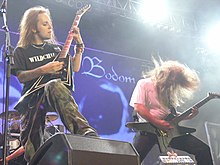 Metal remained popular in the 2000s, particularly in continental Europe. By the new millennium Scandinavia had emerged as one of the areas producing innovative and successful bands, while Belgium, Holland and especially Germany were the most significant markets.[297] Established continental metal bands that placed multiple albums in the top 20 of the German charts between 2003 and 2008, including Finnish band Children of Bodom,[298] Norwegian act Dimmu Borgir,[299] Germany's Blind Guardian[300] and Sweden's HammerFall.[301]
Metalcore, originally an American hybrid of thrash metal and hardcore punk, emerged as a commercial force in the mid-2000s.[302][303] It was rooted in the crossover thrash style developed two decades earlier by bands such as Suicidal Tendencies, Dirty Rotten Imbeciles, and Stormtroopers of Death and remained an underground phenomenon through the 1990s.[304] By 2004, melodic metalcore, influenced by melodic death metal, was sufficiently popular for Killswitch Engage's The End of Heartache and Shadows Fall's The War Within to debut at number 21 and number 20, respectively, on the Billboard album chart.[305][306] Bullet for My Valentine, from Wales, broke into the top 5 in both the U.S. and British charts with Scream Aim Fire (2008).[307] Metalcore bands have received prominent slots at Ozzfest and the Download Festival.[308] Lamb of God, with a related blend of metal styles, reached number 2 on the Billboard charts in 2009 with Wrath.[309]
The success of these bands and others such as Trivium, who have released both metalcore and straight-ahead thrash albums, and Mastodon, who played in a progressive/sludge style, inspired claims of a metal revival in the United States, dubbed by some critics the "New Wave of American Heavy Metal".[310][311] Its roots have been traced to the music of acts like Pantera, Biohazard and Machine Head, drawing on New York hardcore, thrash metal and punk, helping to inspire a move away from the Nu Metal of the early 2000s and a return to riffs and guitar solos.[312][313]
The term "retro-metal" has been applied to such bands as Texas-based The Sword, California's High on Fire, Sweden's Witchcraft, and Australia's Wolfmother.[314] The Sword's Age of Winters (2006), drew heavily on the work of Black Sabbath and Pentagram,[315] while Witchcraft added elements of folk and psychedelic rock[316] and Wolfmother's self-titled 2005 debut album combined elements of the sounds of Deep Purple and Led Zeppelin.[317]
 Gaspard Augé and Xavier de Rosnay of Justice in 2001In the 2000s, as computer technology became more accessible and music software advanced, it became possible to create high quality music using little more than a single laptop computer.[318] This resulted in a massive increase in the amount of home-produced electronic music available to the general public via the expanding internet,[319] and new forms of performance such as laptronica[318] and live coding.[320] These techniques also began to be used by existing bands, as with industrial rock act Nine Inch Nails' album Year Zero (2007),[321] and by developing genres that mixed rock with digital techniques and sounds, including indie electronic, electroclash, dance-punk and new rave.
Indie electronic, which had begun in the early '90s with bands like Stereolab and Disco Inferno, took off in the new millennium as the new digital technology developed, with acts including Broadcast from the UK, Justice from France, Lali Puna from Germany and The Postal Service, and Ratatat from the US, mixing a variety of indie sounds with electronic music, largely produced on small independent labels.[322][323] The Electroclash sub-genre began in New York at the end of the 1990s, combining synth pop, techno, punk and performance art. It was pioneered by I-F with their track "Space Invaders Are Smoking Grass" (1998),[324] and pursued by artists including Felix da Housecat,[325] Peaches, Chicks on Speed,[326] and Ladytron.[327] It gained international attention at the beginning of the new millennium and spread to scenes in London and Berlin, but rapidly faded as a recognisable genre.[328] Dance-punk, mixing post-punk sounds with disco and funk, had developed in the 1980s, but it was revived among some bands of the garage rock/post-punk revival in the early years of the new millennium, particularly among New York acts such as Liars, The Rapture and Radio 4, joined by dance-oriented acts who adopted rock sounds such as Out Hud.[329] In Britain the combination of indie with dance-punk was dubbed new rave in publicity for The Klaxons and the term was picked up and applied by the NME to bands[330] including Trash Fashion,[331] New Young Pony Club,[332] Hadouken!, Late of the Pier, Test Icicles[333] and Shitdisco,[330] forming a scene with a similar visual aesthetic to earlier rave music.[330][334]
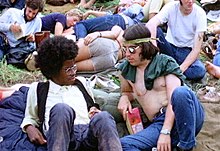 The 1969 Woodstock Festival was seen as a celebration of the counter-cultural lifestyle.The worldwide popularity of rock music meant that it became a major influence on culture, fashion and social attitudes. Different sub-genres of rock were adopted by, and became central to, the identity of a large number of sub-cultures. In the 1950s and 1960s, respectively, British youths adopted the Teddy Boy and Rockers subcultures, which revolved around US rock and roll.[335] The counter-culture of the 1960s was closely associated with psychedelic rock.[335] The mid-1970s punk subculture began in the US, but it was given a distinctive look by British designer Vivian Westwood, a look which spread worldwide.[336] Out of the punk scene, the Goth and Emo subcultures grew, both of which presented distinctive visual styles.[337]
When an international rock culture developed, it was able to supplant cinema as the major sources of fashion influence.[338] Paradoxically, followers of rock music have often mistrusted the world of fashion, which has been seen as elevating image above substance.[338] Rock fashions have been seen as combining elements of different cultures and periods, as well as expressing divergent views on sexuality and gender, and rock music in general has been noted and criticised for facilitating greater sexual freedom.[338][339] Rock has also been associated with various forms of drug use, including the stimulants taken by some mods in the early to mid-1960s, through the LSD linked with psychedelic rock in the late 1960s and early 1970s; and sometimes to cannabis, cocaine and heroin, all of which have been eulogised in song.[340][341]
Rock has been credited with changing attitudes to race by opening up African-American culture to white audiences; but at the same time, rock has been accused of appropriating and exploiting that culture.[342][343] While rock music has absorbed many influences and introduced Western audiences to different musical traditions,[344] the global spread of rock music has been interpreted as a form of cultural imperialism.[345] Rock music inherited the folk tradition of protest song, making political statements on subjects such as war, religion, poverty, civil rights, justice and the environment.[346] Political activism reached a mainstream peak with the "Do They Know It's Christmas?" single (1984) and Live Aid concert for Ethiopia in 1985, which, while successfully raising awareness of world poverty and funds for aid, have also been criticised (along with similar events), for providing a stage for self-aggrandisement and increased profits for the rock stars involved.[347]
Since its early development rock music has been associated with rebellion against social and political norms, most obviously in early rock and roll's rejection of an adult-dominated culture, the counter-culture's rejection of consumerism and conformity and punk's rejection of all forms of social convention,[348] however, it can also be seen as providing a means of commercial exploitation of such ideas and of diverting youth away from political action.[349]
"Popular music, unlike art music, is (1) conceived for mass distribution to large and often socioculturally heterogeneous groups of listeners, (2) stored and distributed in non-written form, (3) only possible in an industrial monetary economy where it becomes a commodity and (4) in capitalist societies,subject to the laws of 'free' enterprise, according to which it should ideally sell as much as possible of as little as possible to as many as possible" [4]For Richard Middleton and Peter Manuel, "a common approach to defining popular music is to link popularity with scale of activity", such as "sales of sheet music or recordings".[6] This approach has a problem, in that "repeat hearings are not counted, depth of response does not feature, socially diverse audiences are treated as one aggregated market and there is no differentiation between musical styles".[6] Another way to define popular music is "to link popularity with means of dissemination" (e.g., being aired on the radio); however, this is problematic, because "all sorts of music, from folk to avant garde, are subject to mass mediation".[6] A third approach to defining popular music is to based on "social group – either a mass audience or a particular class (most often, though not always) the working class", an approach which is problematic because social structures cannot simply be overlain onto musical styles. These three approaches are "too partial" and "too static". Moreover, "understandings of popular music have changed with time".[6]
"The most significant feature of the emergent popular music industry of the late 18th and early 19th centuries was the extent of its focus on the commodity form of sheet music".[6] The availability of inexpensive, widely-available sheet music versions of popular songs and instrumental music pieces made it possible for music to be disseminated to a wide audience of amateur music-makers, who could play and sing popular music at home. In addition to the influence of sheet music, another factor was the increasing availability during the late 18th and early 19th century of public popular music performances in "pleasure gardens and dance halls, popular theatres and concert rooms".[6] The early popular music performers worked hand-in-hand with the sheet music industry to promote popular sheet music. One of the early popular music performers to attain widespread popularity was Jenny Lind, who toured the US in the mid-19th century. During the 19th century, more regular people began getting involved in music by participating in amateur choirs or joining brass bands.
The centre of the music publishing industry in the US during the late 19th century was in New York's 'Tin Pan Alley' district. The Tin Pan Alley music publishers developed a new method for promoting sheet music: incessant promotion of new songs. One of the technological innovations that helped to spread popular music around the turn of the century was player pianos; these allowed people to hear the new popular piano tunes.[6] By the early 1900s, the big trends in popular music were the increasing popularity of vaudeville theaters and dance halls and the new invention—the gramophone player. The record industry grew very rapidly; "By 1920 there were almost 80 record companies in Britain, and almost 200 in the USA".[6] Radio broadcasting of music, which began in the early 1920s, helped to spread popular songs to a huge audience. Another factor which helped to disseminate popular music was the introduction of "talking pictures"--sound films—in the late 1920s. In the late 1920s and throughout the 1930s, there was a move towards consolidation in the recording industry which led several major companies to dominate the record industry.[6]
In the 1950s and 1960s, television began to play an increasingly important role in disseminating new popular music. Variety shows regularly showcased popular singers and bands. In the 1960s, the development of new technologies in recording such as multitrack recorders gave sound engineers an increasingly important role in popular music. By using recording techniques, sound engineers could create new sounds and sound effects that were not possible using traditional "live" recording techniques.[6]
In the 1970s, the trend towards consolidation in the recording industry continued to the point that the "... dominance was in the hands of five huge transnational organizations, three American-owned (WEA, RCA, CBS) and two European-owned [companies] (EMI, Polygram)". In the 1990s, the consolidation trend took a new turn: inter-media consolidation. This trend saw music recording companies being consolidated with film, television, magazines, and other media companies, an approach which facilitated cross-marketing promotion between subsidiaries. For example, a record company's singing star could be cross-promoted by the firm's television and magazine arms.[6]
In the 1990s, popular music was changed by the "introduction of digital equipment (mixing desks, synthesizers, samplers, sequencers)" which allowed the creation of "new sound worlds" and facilitated DIY music production by amateur musicians and " tiny independent record labels".[6] Another trend which affected popular music was the increasing availability and use of computers and Internet connections, which facilitated the dissemination—both legal and illegal—of digital recordings and digital versions of sheet music and lyrics.
Rock music is a genre of popular music that developed during and after the 1960s, particularly in the United Kingdom and the United States. It has its roots in 1940s and 1950s rock and roll, itself heavily influenced by rhythm and blues and country music. Rock music also drew strongly on a number of other genres such as blues and folk, and incorporated influences from jazz, classical and other musical sources.
Musically, rock has centred around the electric guitar, usually as part of a rock group with bass guitar and drums. Typically, rock is song-based music with a 4/4 beat utilizing a verse-chorus form, but the genre has become extremely diverse and common musical characteristics are difficult to define. Like pop music, lyrics often stress romantic love but also address a wide variety of other themes that are frequently social or political in emphasis. The dominance of rock by white, male musicians has been seen as one of the key factors shaping the themes explored in rock music. Rock places a higher degree of emphasis on musicianship, live performance, and an ideology of authenticity than pop music.
By the late 1960s a number of distinct rock music sub-genres had emerged, including hybrids like blues-rock, folk rock, country rock, and jazz-rock fusion, many of which contributed to the development of psychedelic rock influenced by the counter-cultural psychedelic scene. New genres that emerged from this scene included progressive rock, which extended the artistic elements; glam rock, which highlighted showmanship and visual style, and the diverse and enduring major sub-genre of heavy metal, which emphasized volume, power and speed. In the second half of the 1970s, punk rock both intensified and reacted against some of these trends to produce a raw, energetic form of music characterized by overt political and social critiques. Punk was an influence into the 1980s on the subsequent development of other sub-genres, including New Wave, post punk and eventually the alternative rock movement. From the 1990s alternative rock began to dominate rock music and break through into the mainstream in the form of grunge, Britpop, and indie rock. Further fusion sub-genres have since emerged, including pop punk, rap rock, and rap metal, as well as conscious attempts to revisit rock's history, including the garage rock/post punk revival at the beginning of the new millennium.
Rock music has also embodied and served as the vehicle for cultural and social movements, leading to major sub-cultures including mods and rockers in the UK and the "hippie" counterculture that spread out from San Francisco in the US in the 1960s. Similarly, 1970s punk culture spawned the visually distinctive goth and emo subcultures. Inheriting the folk tradition of the protest song, rock music has been associated with political activism as well as changes in social attitudes to race, sex and drug use, and is often seen as an expression of youth revolt against adult consumerism and conformity.
Post-hardcore and emo
Post-hardcore developed in the US, particularly in the Chicago and Washington, D.C areas, in the early-to-mid 1980s, with bands that were inspired by the do-it-yourself ethics and guitar-heavy music of hardcore punk, but influenced by post-punk, adopting longer song formats, more complex musical structures and sometimes more melodic lyrics. Existing bands that moved on from hardcore included Fugazi.[253] From the late 1980s they were followed by bands including Quicksand,[254] Girls Against Boys[255] and The Jesus Lizard.[256] Bands that formed in the 1990s included Thursday,[257] Thrice,[258] Finch,[259] and Poison the Well.[260]Emo also emerged from the hardcore scene in 1980s Washington, D.C., initially as "emocore", used as a term to describe bands who favored expressive vocals over the more common abrasive, barking style.[261] The style was pioneered by bands Rites of Spring and Embrace, the last formed by Ian MacKaye, whose Dischord Records became a major centre for the emerging D.C. emo scene, releasing work by Rites of Spring, Dag Nasty, Nation of Ulysses and Fugazi.[261] Fugazi emerged as the definitive early emo band, gaining a fanbase among alternative rock followers, not least for their overtly anti-commercial stance.[261] The early emo scene operated as an underground, with short-lived bands releasing small-run vinyl records on tiny independent labels.[261] The mid-'90s sound of emo was defined by bands like Jawbreaker and Sunny Day Real Estate who incorporated elements of grunge and more melodic rock.[262] Only after the breakthrough of grunge and pop punk into the mainstream did emo come to wider attention with the success of Weezer's Pinkerton (1996) album, which utilised pop punk.[261] Late 1990s bands drew on the work of Fugazi, SDRE, Jawbreaker and Weezer, including The Promise Ring, The Get Up Kids, Braid, Texas Is the Reason, Joan of Arc, Jets to Brazil and most successfully Jimmy Eat World, and by the end of the millennium it was one of the more popular indie styles in the US.[261]
Emo broke into mainstream culture in the early 2000s with the platinum-selling success of Jimmy Eat World's Bleed American (2001) and Dashboard Confessional's The Places You Have Come to Fear the Most (2003).[263] The new emo had a much more mainstream sound then in the 90s and a far greater appeal amongst adolescents than its earlier incarnations.[263] At the same time, use of the term emo expanded beyond the musical genre, becoming associated with fashion, a hairstyle and any music that expressed emotion.[264] The term emo has been applied by critics and journalists to a variety of artists, including multi-platinum acts such as Fall Out Boy[265] and My Chemical Romance[266] and disparate groups such as Paramore[265] and Panic at the Disco,[267] even when they protest the label. By 2003 post-hardcore bands had also caught the attention of major labels and began to enjoy mainstream success in the album charts.[257][258] A number of these bands were seen as a more aggressive offshoot of emo and given the often vague label of screamo.[268] Around this time, a new wave of post-hardcore bands began to emerge onto the scene that incorporated more pop punk and alternative rock styles into their music, including The Used,[269] Hawthorne Heights,[270] Senses Fail,[271] From First to Last[272] and Emery[273] and Canadian bands Silverstein[274] and Alexisonfire.[275] British bands like Funeral For A Friend,[276] The Blackout[277] and Enter Shikari also made headway.[278]
[edit] Garage rock/post-punk revival
Main articles: Garage rock revival and Post-punk revival

The commercial breakthrough from these scenes was led by four bands: The Strokes, who emerged from the New York club scene with their début album Is This It (2001); The White Stripes, from Detroit, with their third album White Blood Cells (2001); The Hives from Sweden after their compilation album Your New Favourite Band (2001); and The Vines from Australia with Highly Evolved (2002).[291] They were christened by the media as the "The" bands, and dubbed "The saviours of rock 'n' roll", leading to accusations of hype.[292] A second wave of bands that managed to gain international recognition as a result of the movement included Black Rebel Motorcycle Club, The Killers, Interpol and Kings of Leon from the US,[293] The Libertines, Arctic Monkeys, Bloc Party, Editors, Franz Ferdinand and Placebo from the UK,[294] Jet from Australia[295] and The Datsuns and The D4 from New Zealand.[296]
[edit] Contemporary heavy metal, metalcore and retro metal
Main article: Heavy metal music
See also: Metalcore and New Wave of American Heavy Metal

Metalcore, originally an American hybrid of thrash metal and hardcore punk, emerged as a commercial force in the mid-2000s.[302][303] It was rooted in the crossover thrash style developed two decades earlier by bands such as Suicidal Tendencies, Dirty Rotten Imbeciles, and Stormtroopers of Death and remained an underground phenomenon through the 1990s.[304] By 2004, melodic metalcore, influenced by melodic death metal, was sufficiently popular for Killswitch Engage's The End of Heartache and Shadows Fall's The War Within to debut at number 21 and number 20, respectively, on the Billboard album chart.[305][306] Bullet for My Valentine, from Wales, broke into the top 5 in both the U.S. and British charts with Scream Aim Fire (2008).[307] Metalcore bands have received prominent slots at Ozzfest and the Download Festival.[308] Lamb of God, with a related blend of metal styles, reached number 2 on the Billboard charts in 2009 with Wrath.[309]
The success of these bands and others such as Trivium, who have released both metalcore and straight-ahead thrash albums, and Mastodon, who played in a progressive/sludge style, inspired claims of a metal revival in the United States, dubbed by some critics the "New Wave of American Heavy Metal".[310][311] Its roots have been traced to the music of acts like Pantera, Biohazard and Machine Head, drawing on New York hardcore, thrash metal and punk, helping to inspire a move away from the Nu Metal of the early 2000s and a return to riffs and guitar solos.[312][313]
The term "retro-metal" has been applied to such bands as Texas-based The Sword, California's High on Fire, Sweden's Witchcraft, and Australia's Wolfmother.[314] The Sword's Age of Winters (2006), drew heavily on the work of Black Sabbath and Pentagram,[315] while Witchcraft added elements of folk and psychedelic rock[316] and Wolfmother's self-titled 2005 debut album combined elements of the sounds of Deep Purple and Led Zeppelin.[317]
[edit] Digital electronic rock
Main article: Electronic rock

Indie electronic, which had begun in the early '90s with bands like Stereolab and Disco Inferno, took off in the new millennium as the new digital technology developed, with acts including Broadcast from the UK, Justice from France, Lali Puna from Germany and The Postal Service, and Ratatat from the US, mixing a variety of indie sounds with electronic music, largely produced on small independent labels.[322][323] The Electroclash sub-genre began in New York at the end of the 1990s, combining synth pop, techno, punk and performance art. It was pioneered by I-F with their track "Space Invaders Are Smoking Grass" (1998),[324] and pursued by artists including Felix da Housecat,[325] Peaches, Chicks on Speed,[326] and Ladytron.[327] It gained international attention at the beginning of the new millennium and spread to scenes in London and Berlin, but rapidly faded as a recognisable genre.[328] Dance-punk, mixing post-punk sounds with disco and funk, had developed in the 1980s, but it was revived among some bands of the garage rock/post-punk revival in the early years of the new millennium, particularly among New York acts such as Liars, The Rapture and Radio 4, joined by dance-oriented acts who adopted rock sounds such as Out Hud.[329] In Britain the combination of indie with dance-punk was dubbed new rave in publicity for The Klaxons and the term was picked up and applied by the NME to bands[330] including Trash Fashion,[331] New Young Pony Club,[332] Hadouken!, Late of the Pier, Test Icicles[333] and Shitdisco,[330] forming a scene with a similar visual aesthetic to earlier rave music.[330][334]
[edit] Social impact
Main article: Social effects of rock music

When an international rock culture developed, it was able to supplant cinema as the major sources of fashion influence.[338] Paradoxically, followers of rock music have often mistrusted the world of fashion, which has been seen as elevating image above substance.[338] Rock fashions have been seen as combining elements of different cultures and periods, as well as expressing divergent views on sexuality and gender, and rock music in general has been noted and criticised for facilitating greater sexual freedom.[338][339] Rock has also been associated with various forms of drug use, including the stimulants taken by some mods in the early to mid-1960s, through the LSD linked with psychedelic rock in the late 1960s and early 1970s; and sometimes to cannabis, cocaine and heroin, all of which have been eulogised in song.[340][341]
Rock has been credited with changing attitudes to race by opening up African-American culture to white audiences; but at the same time, rock has been accused of appropriating and exploiting that culture.[342][343] While rock music has absorbed many influences and introduced Western audiences to different musical traditions,[344] the global spread of rock music has been interpreted as a form of cultural imperialism.[345] Rock music inherited the folk tradition of protest song, making political statements on subjects such as war, religion, poverty, civil rights, justice and the environment.[346] Political activism reached a mainstream peak with the "Do They Know It's Christmas?" single (1984) and Live Aid concert for Ethiopia in 1985, which, while successfully raising awareness of world poverty and funds for aid, have also been criticised (along with similar events), for providing a stage for self-aggrandisement and increased profits for the rock stars involved.[347]
Since its early development rock music has been associated with rebellion against social and political norms, most obviously in early rock and roll's rejection of an adult-dominated culture, the counter-culture's rejection of consumerism and conformity and punk's rejection of all forms of social convention,[348] however, it can also be seen as providing a means of commercial exploitation of such ideas and of diverting youth away from political action.[349]
Subscribe to:
Comments (Atom)